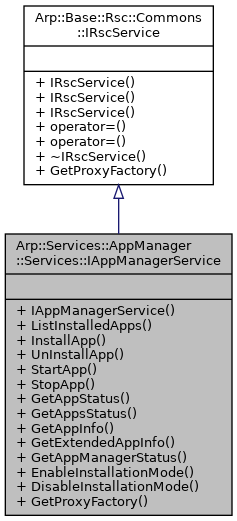
This services represents the RSC-Interface for the AppManager service component More...
#include <IAppManagerService.hpp>
Public Types | |
| using | Ptr = std::shared_ptr< IAppManagerService > |
 Public Types inherited from Arp::Base::Rsc::Commons::IRscService Public Types inherited from Arp::Base::Rsc::Commons::IRscService | |
| using | Ptr = std::shared_ptr< IRscService > |
| The shared_ptr type of IRscService. | |
Public Member Functions | |
| IAppManagerService (void)=default | |
| Constructs an IAppManagerService instance. | |
| virtual AppManagerServiceError | ListInstalledApps (std::vector< AppInfo > &list)=0 |
| Lists all installed PLCnext Technology Apps by their identifier. More... | |
| virtual AppManagerServiceError | InstallApp (const RscString< 512 > &filename, const RscString< 256 > &appIdentifier="")=0 |
| Installs a PLCnext Technology App from an app container file located on the controller (path specified by filename ). May also be used to update an already installed app. More... | |
| virtual AppManagerServiceError | UnInstallApp (const RscString< 256 > &appIdentifier)=0 |
| Uninstalls an app specified by its identifier. More... | |
| virtual AppManagerServiceError | StartApp (const RscString< 256 > &appIdentifier)=0 |
| Starts the PLCnext application specified by appIdentifier . The app may start asynchronously; during startup the per‑app status contains Arp.Services.AppManager.Services.AppStatus.Starting. The app is considered fully started when the status is Arp.Services.AppManager.Services.AppStatus.Started. More... | |
| virtual AppManagerServiceError | StopApp (const RscString< 256 > &appIdentifier)=0 |
| Stops the PLCnext application specified by appIdentifier . The app may stop asynchronously; during shutdown the per‑app status contains Arp.Services.AppManager.Services.AppStatus.Stopping. The app is considered fully stopped when the status is Arp.Services.AppManager.Services.AppStatus.Stopped. More... | |
| virtual AppManagerServiceError | GetAppStatus (const RscString< 256 > &appIdentifier, AppStatus &status)=0 |
| Reads the status of the app specified by appIdentifier . More... | |
| virtual AppManagerServiceError | GetAppsStatus (const std::vector< RscString< 256 > > &appIdentifiers, std::vector< AppStatus > &status)=0 |
| Reads the statuses of apps specified by appIdentifiers . If an identifier no longer exists, an error code is returned and the corresponding status in the result array is Arp.Services.AppManager.Services.AppStatus.None. More... | |
| virtual AppManagerServiceError | GetAppInfo (const RscString< 256 > &appIdentifier, AppInfo &appInfo)=0 |
| Reads the app information for the app specified by appIdentifier . More... | |
| virtual AppManagerServiceError | GetExtendedAppInfo (const RscString< 256 > &appIdentifier, const RscString< 256 > &extendedInfoKey, RscVariant< 256 > &infoItem)=0 |
| Retrieves extended information for the specified application based on the provided key. More... | |
| virtual AppManagerStatus | GetAppManagerStatus ()=0 |
| Reads the status of the App Manager. More... | |
| virtual AppManagerServiceError | EnableInstallationMode (const RscString< 256 > &callerName)=0 |
Enables the installation mode of the App Manager using the specified user name. Only with active installation mode is it possible to call the following methods: Arp.Services.AppManager.Services.IAppManagerService.InstallApp, Arp.Services.AppManager.Services.IAppManagerService.UnInstallApp, Arp.Services.AppManager.Services.IAppManagerService.StartApp, Arp.Services.AppManager.Services.IAppManagerService.StopApp. If these methods are called with installation mode disabled, they return InstallationModeInactive. More... | |
| virtual AppManagerServiceError | DisableInstallationMode (boolean autoRestartDisabled=false)=0 |
| Disables the installation mode of the App Manager. If a reboot is required by previous install/start/stop operations, it is performed right after this returns unless explicitly disabled. Call this method only when the App Manager status is Arp.Services.AppManager.Services.AppManagerStatus.Ready. More... | |
| virtual AppManagerServiceError | GetExtendedAppManagerInfo (const RscString< 256 > &extendedInfoKey, RscVariant< 256 > &infoItem)=0 |
| Retrieves extended App Manager information based on the provided key. More... | |
| Public Member Functions inherited from Arp::Base::Rsc::Commons::IRscService | |
| IRscService (void)=default | |
| The default constructor. | |
| IRscService (const IRscService &arg)=delete | |
| The deleted copy constructor. More... | |
| IRscService (IRscService &&arg) noexcept=default | |
| The default move constructor. More... | |
| IRscService & | operator= (const IRscService &arg)=delete |
| The deleted assignment operator. More... | |
| IRscService & | operator= (IRscService &&arg) noexcept=default |
| The default move-assignment operator. More... | |
| virtual | ~IRscService (void)=default |
| Destructs this instance and frees all resources. | |
Static Public Member Functions | |
| static IRscServiceProxyFactory & | GetProxyFactory (void) |
| Static Public Member Functions inherited from Arp::Base::Rsc::Commons::IRscService | |
| static IRscServiceProxyFactory & | GetProxyFactory (void) |
| Returns a reference to service proxy factory to create a proxy instance of this service. More... | |
Detailed Description
This services represents the RSC-Interface for the AppManager service component
This service provides methods for managing PLCnext Technology Apps installed on the target.
Operational model and asynchronous behavior
- Serialization of management actions: The App Manager processesonly one app management operation at a time. While the manager is in any non-Arp.Services.AppManager.Services.AppManagerStatus.Ready state (e.g. Arp.Services.AppManager.Services.AppManagerStatus.InstallingApp, Arp.Services.AppManager.Services.AppManagerStatus.StartingApp), all other management calls (Arp.Services.AppManager.Services.IAppManagerService.InstallApp, Arp.Services.AppManager.Services.IAppManagerService.UnInstallApp, Arp.Services.AppManager.Services.IAppManagerService.StartApp, Arp.Services.AppManager.Services.IAppManagerService.StopApp) are rejected. Clients must wait untilArp.Services.AppManager.Services.AppManagerStatus.Ready is reported before issuing the next management action.
- All app management actions Arp.Services.AppManager.Services.IAppManagerService.InstallApp, Arp.Services.AppManager.Services.IAppManagerService.UnInstallApp, Arp.Services.AppManager.Services.IAppManagerService.StartApp, and Arp.Services.AppManager.Services.IAppManagerService.StopApp are asynchronous. A successful return with error code Arp.Services.AppManager.Services.AppManagerErrorCode.None only indicates that the operation was accepted and initiated; completion must be observed via status polling.
-
To perform any app management action, installation mode must be enabled via Arp.Services.AppManager.Services.IAppManagerService.EnableInstallationMode. Calling these methods with installation mode disabled returns an error indicating
InstallationModeInactive. The App Manager exposes the Arp.Services.AppManager.Services.AppManagerStatus.InstallationModeEnabled flag to indicate the mode state. -
The return value of management methods is Arp.Services.AppManager.Services.AppManagerServiceError. If the embedded error code equals
AppManagerErrorCode.None, then the App Manager found no fundamental issues (e.g., configuration or mount problems) and the asynchronous operation was started successfully. - On acceptance, the App Manager transitions its state to Arp.Services.AppManager.Services.AppManagerStatus.InstallingApp, Arp.Services.AppManager.Services.AppManagerStatus.UninstallingApp, Arp.Services.AppManager.Services.AppManagerStatus.StartingApp, or Arp.Services.AppManager.Services.AppManagerStatus.StoppingApp. When the operation is fully done, it returns to Arp.Services.AppManager.Services.AppManagerStatus.Ready.
- Client applications must poll Arp.Services.AppManager.Services.IAppManagerService.GetAppManagerStatus until Arp.Services.AppManager.Services.AppManagerStatus.Ready is observed (e.g., every 250 ms) before taking any follow‑up action.
-
After the manager returns to Arp.Services.AppManager.Services.AppManagerStatus.Ready, check whether Arp.Services.AppManager.Services.AppManagerStatus.InstallError is set. If set, call Arp.Services.AppManager.Services.IAppManagerService.GetExtendedAppManagerInfo with the keys
LastInstallErrorCodeandLastInstallErrorMessageto obtain the precise error code (Arp.Services.AppManager.Services.AppManagerErrorCode) and description. These values are reset on the next install/uninstall action. -
Start/Stop errors are app‑specific: read them via Arp.Services.AppManager.Services.IAppManagerService.GetAppStatus. In error cases, the app status exposes Arp.Services.AppManager.Services.AppStatus.StartError and/or Arp.Services.AppManager.Services.AppStatus.StopError. To retrieve error details (code and message) for the last async start/stop operation, call Arp.Services.AppManager.Services.IAppManagerService.GetExtendedAppInfo with
CurrentAppErrorCodeandCurrentAppErrorMessage. These are cleared on the next start/stop action. - Error flags are reset by performing the corresponding operation again: installation errors on the next install/uninstall, and start/stop errors on the next start/stop of the app.
- End of session: call Arp.Services.AppManager.Services.IAppManagerService.DisableInstallationMode when Arp.Services.AppManager.Services.AppManagerStatus.Ready is reported. If a reboot is required (Arp.Services.AppManager.Services.AppManagerStatus.RestartRequired), the manager may schedule it immediately unless the parameter 'autoRestartDisabled' is set. A reboot is required and will be performed if any app , if at least one started or stopped app requires a restart. Remark: parameter 'autoRestartDisabled' is ignored in current implementation.
Impact on real-time behaviour: Executing app management actions (Arp.Services.AppManager.Services.IAppManagerService.InstallApp, Arp.Services.AppManager.Services.IAppManagerService.UnInstallApp, Arp.Services.AppManager.Services.IAppManagerService.StartApp, Arp.Services.AppManager.Services.IAppManagerService.StopApp) may adversely affect the system's real-time behavior and can cause real-time violations. These operations must not be executed during productive operation.
This service is defined in library Arp.Services.AppManager.
Realtime Usage: This API call does not have to be deterministic in runtime behaviour, so an asynchronous execution should be considered.
Member Function Documentation
◆ DisableInstallationMode()
|
pure virtual |
Disables the installation mode of the App Manager. If a reboot is required by previous install/start/stop operations, it is performed right after this returns unless explicitly disabled. Call this method only when the App Manager status is Arp.Services.AppManager.Services.AppManagerStatus.Ready.
- Parameters
-
autoRestartDisabled If true, prevents automatic restart even if required.
- Returns
-
AppManagerErrorCode.None— no reboot is required/performed. -
AppManagerErrorCode.RestartScheduled— a reboot will be performed. -
AppManagerErrorCode.InstallationModeInactive— installation mode was not active.
-
◆ EnableInstallationMode()
|
pure virtual |
Enables the installation mode of the App Manager using the specified user name. Only with active installation mode is it possible to call the following methods: Arp.Services.AppManager.Services.IAppManagerService.InstallApp, Arp.Services.AppManager.Services.IAppManagerService.UnInstallApp, Arp.Services.AppManager.Services.IAppManagerService.StartApp, Arp.Services.AppManager.Services.IAppManagerService.StopApp. If these methods are called with installation mode disabled, they return InstallationModeInactive.
- Parameters
-
callerName The name of the user enabling installation mode.
- Returns
-
AppManagerErrorCode.None— the installation mode was activated (not acquired by another component). -
AppManagerErrorCode.InstallationModeActive— the installation mode is already active.
-
Behavior: Activates installation mode if not already active. The flag Arp.Services.AppManager.Services.AppManagerStatus.InstallationModeEnabled indicates the current mode.
◆ GetAppInfo()
|
pure virtual |
Reads the app information for the app specified by appIdentifier .
- Parameters
-
appIdentifier The app identifier. appInfo On return, contains the Arp.Services.AppManager.Services.AppInfo for the app.
◆ GetAppManagerStatus()
|
pure virtual |
Reads the status of the App Manager.
Arp.Services.AppManager.Services.AppManagerStatus is a bit field. Use Arp.Services.AppManager.Services.AppManagerStatus.StateMask (0x3F) to extract the primary state and Arp.Services.AppManager.Services.AppManagerStatus.FlagsMask to test flags including Arp.Services.AppManager.Services.AppManagerStatus.InstallationModeEnabled, Arp.Services.AppManager.Services.AppManagerStatus.RestartRequired, and Arp.Services.AppManager.Services.AppManagerStatus.InstallError.
◆ GetAppsStatus()
|
pure virtual |
Reads the statuses of apps specified by appIdentifiers . If an identifier no longer exists, an error code is returned and the corresponding status in the result array is Arp.Services.AppManager.Services.AppStatus.None.
- Parameters
-
appIdentifiers The app identifiers. status On return, contains the Arp.Services.AppManager.Services.AppStatus values for the requested apps.
Arp.Services.AppManager.Services.AppStatus is a bit field. Use Arp.Services.AppManager.Services.AppStatus.StateMask and Arp.Services.AppManager.Services.AppStatus.FlagsMask for parsing.
◆ GetAppStatus()
|
pure virtual |
Reads the status of the app specified by appIdentifier .
- Parameters
-
appIdentifier The app identifier. status On return, contains the Arp.Services.AppManager.Services.AppStatus of the app.
Arp.Services.AppManager.Services.AppStatus is a bit field. Use Arp.Services.AppManager.Services.AppStatus.StateMask (0x3F) to extract the primary state and Arp.Services.AppManager.Services.AppStatus.FlagsMask for flags such as Arp.Services.AppManager.Services.AppStatus.StartError or Arp.Services.AppManager.Services.AppStatus.StopError.
◆ GetExtendedAppInfo()
|
pure virtual |
Retrieves extended information for the specified application based on the provided key.
- Parameters
-
appIdentifier The identifier of the application. extendedInfoKey The key specifying the type of extended information to retrieve. infoItem On return, contains the retrieved data if successful.
Supported keys:
- AppRequiresReboot — indicates whether the app requires a reboot for start/stop.
- CurrentAppErrorCode — Arp.Services.AppManager.Services.AppManagerErrorCode of the last error in an async start/stop operation (reset on the next start/stop).
- CurrentAppErrorMessage — human‑readable message of the last async start/stop error (reset on the next start/stop).
◆ GetExtendedAppManagerInfo()
|
pure virtual |
Retrieves extended App Manager information based on the provided key.
- Parameters
-
extendedInfoKey The key specifying the type of extended information to retrieve. infoItem On return, contains the retrieved data if successful.
Supported keys:
-
LastInstallErrorCode — Arp.Services.AppManager.Services.AppManagerErrorCode of the last async install/uninstall error; reset to
AppManagerErrorCode.Noneon next install/uninstall. - LastInstallErrorMessage — message of the last async install/uninstall error; reset to empty string on next install/uninstall.
◆ InstallApp()
|
pure virtual |
Installs a PLCnext Technology App from an app container file located on the controller (path specified by filename ). May also be used to update an already installed app.
- Parameters
-
filename Path to the app container file on the controller. Do not delete the file until the App Manager is Arp.Services.AppManager.Services.AppManagerStatus.Ready again. appIdentifier Optional app identifier. If specified, it is validated against the identifier in the container. If they do not match, the call fails. A unique identifier of a PLCnext Technology App, assigned by the PLCnext Store during app creation. It consists of the Firm Code and the Product Code. See PLCnext App Metadata documentation .
- Returns
- Arp.Services.AppManager.Services.AppManagerServiceError indicating acceptance or failure to start the asynchronous installation.
Preconditions:
- Installation mode must be enabled.
- App Manager status must beArp.Services.AppManager.Services.AppManagerStatus.Ready. See Operational model and asynchronous behavior.
Concurrency: This method can only be called when the App Manager is in stateArp.Services.AppManager.Services.AppManagerStatus.Ready. See Operational model and asynchronous behavior for details.
State transitions: Arp.Services.AppManager.Services.AppManagerStatus.Ready → Arp.Services.AppManager.Services.AppManagerStatus.InstallingApp → Arp.Services.AppManager.Services.AppManagerStatus.Ready.
Polling: Poll Arp.Services.AppManager.Services.IAppManagerService.GetAppManagerStatus (e.g., every 250 ms) until Arp.Services.AppManager.Services.AppManagerStatus.Ready.
Error reporting: If after completion Arp.Services.AppManager.Services.AppManagerStatus.InstallError is set, retrieve LastInstallErrorCode and LastInstallErrorMessage via Arp.Services.AppManager.Services.IAppManagerService.GetExtendedAppManagerInfo. These are reset on the next install/uninstall.
◆ ListInstalledApps()
|
pure virtual |
Lists all installed PLCnext Technology Apps by their identifier.
- Parameters
-
list After the method call, contains a list of the AppInfo structure Arp.Services.AppManager.Services.AppInfo.
- Returns
- Arp.Services.AppManager.Services.AppManagerServiceError:
-
AppManagerServiceError::None— no error occurred. - Otherwise — error code with message.
-
◆ StartApp()
|
pure virtual |
Starts the PLCnext application specified by appIdentifier . The app may start asynchronously; during startup the per‑app status contains Arp.Services.AppManager.Services.AppStatus.Starting. The app is considered fully started when the status is Arp.Services.AppManager.Services.AppStatus.Started.
- Parameters
-
appIdentifier The identifier of the app to be started A unique identifier of a PLCnext Technology App, assigned by the PLCnext Store during app creation. It consists of the Firm Code and the Product Code. See PLCnext App Metadata documentation .
- Returns
- Arp.Services.AppManager.Services.AppManagerServiceError indicating acceptance or failure to start the asynchronous operation.
Preconditions:
- Installation mode must be enabled.
- App Manager status must beArp.Services.AppManager.Services.AppManagerStatus.Ready. See Operational model and asynchronous behavior.
Concurrency: This method can only be called when the App Manager is in stateArp.Services.AppManager.Services.AppManagerStatus.Ready. See Operational model and asynchronous behavior for details.
State transitions (manager): Arp.Services.AppManager.Services.AppManagerStatus.StartingApp → Arp.Services.AppManager.Services.AppManagerStatus.Ready.
State transitions (app): Arp.Services.AppManager.Services.AppStatus.Starting → Arp.Services.AppManager.Services.AppStatus.Started.
Polling: Poll Arp.Services.AppManager.Services.IAppManagerService.GetAppManagerStatus to Arp.Services.AppManager.Services.AppManagerStatus.Ready, then confirm per‑app state with Arp.Services.AppManager.Services.IAppManagerService.GetAppStatus.
Error reporting: If the last start failed, Arp.Services.AppManager.Services.AppStatus.StartError is set. Retrieve details via Arp.Services.AppManager.Services.IAppManagerService.GetExtendedAppInfo using keys CurrentAppErrorCode and CurrentAppErrorMessage. Reset occurs on the next start/stop.
◆ StopApp()
|
pure virtual |
Stops the PLCnext application specified by appIdentifier . The app may stop asynchronously; during shutdown the per‑app status contains Arp.Services.AppManager.Services.AppStatus.Stopping. The app is considered fully stopped when the status is Arp.Services.AppManager.Services.AppStatus.Stopped.
- Parameters
-
appIdentifier The identifier of the app to be stopped A unique identifier of a PLCnext Technology App, assigned by the PLCnext Store during app creation. It consists of the Firm Code and the Product Code. See PLCnext App Metadata documentation .
- Returns
- Arp.Services.AppManager.Services.AppManagerServiceError indicating acceptance or failure to start the asynchronous operation.
Preconditions:
- Installation mode must be enabled.
- App Manager status must beArp.Services.AppManager.Services.AppManagerStatus.Ready. See Operational model and asynchronous behavior.
State transitions (manager): Arp.Services.AppManager.Services.AppManagerStatus.StoppingApp → Arp.Services.AppManager.Services.AppManagerStatus.Ready.
State transitions (app): Arp.Services.AppManager.Services.AppStatus.Stopping → Arp.Services.AppManager.Services.AppStatus.Stopped.
Polling: Same as Arp.Services.AppManager.Services.IAppManagerService.StartApp; confirm per‑app state with Arp.Services.AppManager.Services.IAppManagerService.GetAppStatus.
Error reporting: If the last stop failed, Arp.Services.AppManager.Services.AppStatus.StopError is set. Retrieve details via Arp.Services.AppManager.Services.IAppManagerService.GetExtendedAppInfo using keys CurrentAppErrorCode and CurrentAppErrorMessage. Reset occurs on the next start/stop.
◆ UnInstallApp()
|
pure virtual |
Uninstalls an app specified by its identifier.
- Parameters
-
appIdentifier The identifier of the app to be uninstalled A unique identifier of a PLCnext Technology App, assigned by the PLCnext Store during app creation. It consists of the Firm Code and the Product Code. See PLCnext App Metadata documentation .
- Returns
- Arp.Services.AppManager.Services.AppManagerServiceError indicating acceptance or failure to start the asynchronous uninstallation.
Preconditions:
- Installation mode must be enabled.
- App Manager status must beArp.Services.AppManager.Services.AppManagerStatus.Ready. See Operational model and asynchronous behavior.
Concurrency: This method can only be called when the App Manager is in stateArp.Services.AppManager.Services.AppManagerStatus.Ready. See Operational model and asynchronous behavior for details.
State transitions: Arp.Services.AppManager.Services.AppManagerStatus.UninstallingApp → Arp.Services.AppManager.Services.AppManagerStatus.Ready.
Polling & errors: Same pattern as Arp.Services.AppManager.Services.IAppManagerService.InstallApp; consult Arp.Services.AppManager.Services.IAppManagerService.GetExtendedAppManagerInfo if Arp.Services.AppManager.Services.AppManagerStatus.InstallError is set after completion.
The documentation for this class was generated from the following file:
- Arp/Services/AppManager/Services/IAppManagerService.hpp